Where the Colour Break Falls: Hemlines and Proportion
By Mariah Johnson · Updated
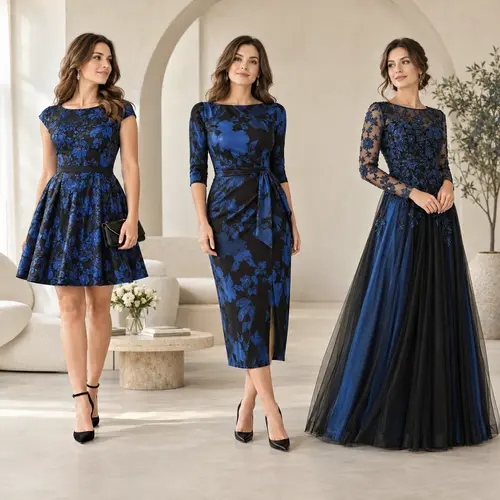
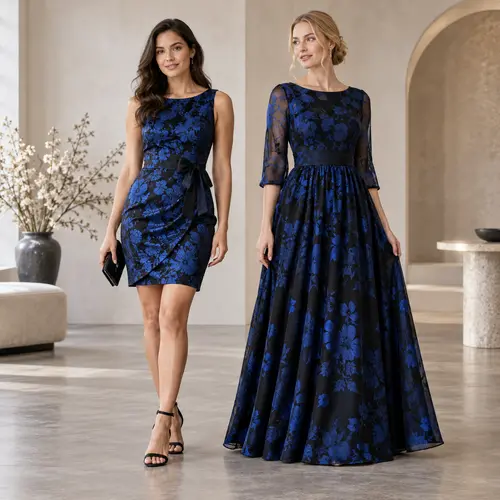
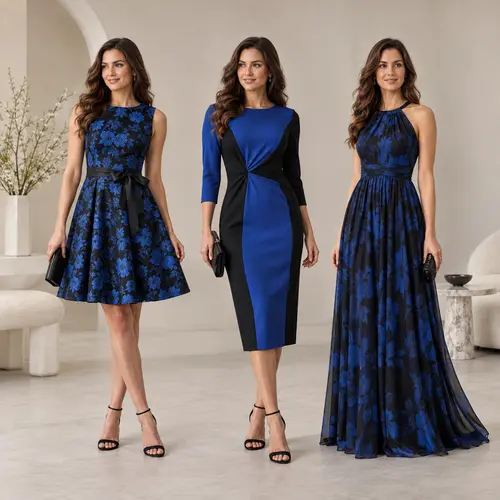
The same placement pattern doesn’t look the same at every length. A bodice split that reads as balanced on a knee-length black and blue dress can look top-heavy on a mini, or oddly empty on a full floor-length blue and black gown.
Whether you’re shopping for a short black and blue dress or a long blue and black gown, checking the hemline against the placement pattern first saves a return.
At a glance
- Short hemlines (mini to knee) favour trim, panels, and smaller bodice splits
- Midi hemlines favour a belt, sash, or panel over a full colour-block
- Long hemlines (ankle to floor) have room for a colour-block, ombre, or a full bodice split
Jump to a section
Hemline by Hemline
| # | Hemline | Common placement | Why |
|---|---|---|---|
| 1 | Mini / thigh-length | Trim or a bodice-only block | There isn't enough vertical space for a full skirt-and-bodice split to read cleanly, so the black portion usually stays small. |
| 2 | Above-knee | Trim or a fitted waist panel | Enough length for a panel without crowding the hem, still short enough that a large colour-block can look top-heavy. |
| 3 | Knee-length | Bodice split or colour-block | The classic proportion point. A roughly even split between blue and black reads balanced at this length. |
| 4 | Tea-length (mid-calf) | Trim or a wide hem band | A black hem band anchors the silhouette without needing a torso split, useful when the bodice is already detailed. |
| 5 | Midi (below calf) | Belt, sash, or panel | See the midi length guide below, this is the length where proportion is hardest to judge from a photo alone. |
| 6 | Ankle-length | Colour-block or ombre | Finally enough vertical distance for a gradient to read as an actual gradient rather than a hard, awkward line. |
| 7 | Floor-length | Bodice split | Remains the most common pattern at this length. See the floor-length hem guide for getting the length itself right. |
None of this is a strict rule. A skilled designer can make a colour-block work on a mini hem or a simple trim work on a cathedral train. It’s a starting point for judging a listing photo before you buy, not a limit on what’s possible.
FAQ
Does hemline length actually change which placement pattern works best?
Yes. A pattern that reads as a clean, balanced split at knee length can look either cramped or oddly proportioned at a much shorter or much longer hem, since the amount of vertical fabric available for the black portion changes with the hem itself. The table above maps which patterns tend to hold up best at each length.
What's the most flattering hemline-to-black ratio?
There's no single correct ratio, but a black portion that takes up roughly a third to a half of the visible dress tends to read as intentional rather than accidental. Much less than that and the black can look like an afterthought trim, much more and the blue can end up feeling like an accent instead of the main colour.
Can a trim pattern work at any hemline length?
Trim is the most forgiving pattern in the nine-pattern guide precisely because it doesn't depend on hemline proportion the way a bodice split or colour-block does. A thin black edge at the hem, neckline, or cuffs works at a mini length and at a full floor-length gown equally well.
Should the black portion be bigger or smaller than the blue portion?
Smaller, in most cases. A blue and black dress where blue is clearly the dominant colour and black plays a supporting role, whether as trim, a panel, or a bodice, tends to photograph and read in person as more deliberate than a dress where the two colours compete for equal visual weight.
Related guides
Mariah Johnson
Editor, Blue and Black Dress
I maintain the shade index and the placement pattern guides on this site, verifying each hex value against real garment photography as I work through the list, and I keep the pairing tables current.
View full bioGet the shade updates
One email when a hex value gets re-verified or a new shade profile goes up. No spam, unsubscribe anytime.