Blue and Black Midi Dresses: Shades and Placements by Style
By Mariah Johnson · Updated
A midi black and blue dress sits between the two extremes covered elsewhere on this site: it doesn’t show as much blue as a short dress, and it doesn’t carry as much black as a long gown before the balance shifts. Where the hem actually falls depends heavily on height, which makes midi the length most likely to arrive different than expected. This guide breaks down which blue and black combinations hold up across three common midi silhouettes.
Whether you search for a midi black and blue dress or a midi blue and black dress, the same three silhouettes account for most of what’s actually for sale: wrap, sheath, and pleated.
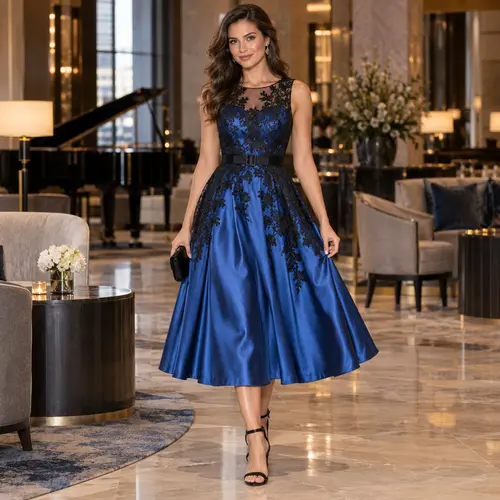
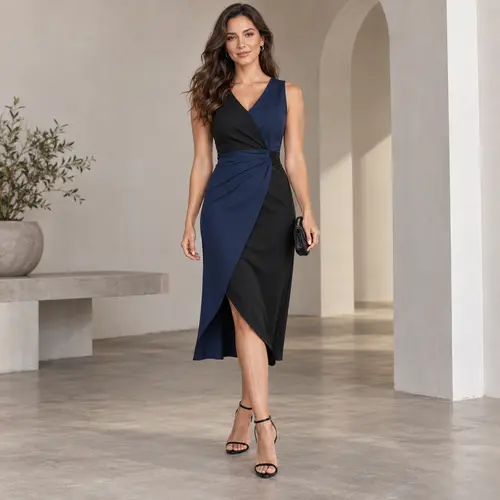
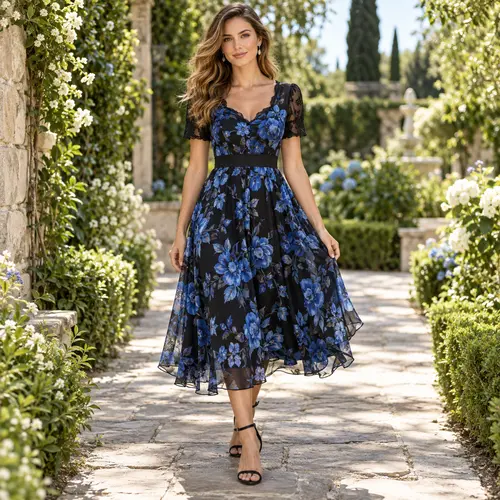
At a glance
- Wrap: a natural focal point at the crossover front, keep additional black minimal
- Sheath: the most height-forgiving silhouette, the safer default for a first midi purchase
- Pleated: fabric movement changes how black trim reads compared to flat fabric
Jump to a section
Wrap
| # | Look | Shade | Placement | Best for | Note |
|---|---|---|---|---|---|
| 1 | Self-tie wrap midi | Teal Blue | Black sash | Wedding guest, garden events | A self-tie sash defines the waist without needing built-in structure, which keeps a wrap midi's drape intact. |
| 2 | V-neck wrap with trim | Cadet Blue | Black trim at V-neck | Office parties, semi-formal | Cadet blue's muted saturation reads as work-appropriate even with a defined black neckline. |
| 3 | Wrap midi with piping | Navy Blue | Black piping at seams | Conservative events, religious ceremonies | Piping is the lowest-contrast placement in this guide, useful when a dress code calls for minimal black. |
Shop this shade
Teal Blue with a black sash is the clearest wrap-midi pairing in this guide, since the sash reinforces the wrap's natural focal point.
Sheath
| # | Look | Shade | Placement | Best for | Note |
|---|---|---|---|---|---|
| 4 | Sheath with piped seams | Dusty Blue | Black piping at shoulder and waist | Mother of the bride | Dusty blue plus piping is the combination least likely to photograph as plain grey under indoor lighting. |
| 5 | Colour-block sheath | Steel Blue | Black colour-block side panel | Office parties, cocktail | A side panel narrows the silhouette more reliably than a front panel does on a straight sheath cut. |
| 6 | Sheath with belt | Classic Blue | Black belt at waist | Wedding guest | Classic blue's muted saturation pairs cleanly with a defined black waistline without looking heavy. |
Shop this shade
Dusty blue with black piping is the most photograph-reliable sheath pairing in this guide.
Pleated
| # | Look | Shade | Placement | Best for | Note |
|---|---|---|---|---|---|
| 7 | Pleated skirt, colour-block bodice | Powder Blue | Black bodice | Bridesmaid | Pleats catch light as they move, which keeps a black bodice from reading as a flat block against the skirt. |
| 8 | Pleated midi with waist trim | Cornflower Blue | Black trim at waist | Daytime semi-formal | Cornflower Blue's warm undertone suits pleated fabric better than cooler blues, which can look stiff in a pressed pleat. |
| 9 | Pleated midi with hem trim | Sapphire Blue | Black trim at hem | Evening semi-formal | Hem trim on a pleated skirt catches light at every pleat edge, which reads as more deliberate than a single flat line. |
Shop this shade
Powder blue with a black bodice is the standard bridesmaid pairing for a pleated midi skirt.
FAQ
Why is midi the hardest length to buy online?
Because where a midi skirt actually ends depends on height in a way short and long lengths don't. A midi that hits mid-calf on a 5'8" model can hit the ankle on a 5'2" buyer, which changes both the silhouette and how much of the black placement is visible when walking. Always check a listing's stated length in inches against your own height rather than relying on the product photo alone.
Does midi read as formal or casual?
It depends on the silhouette more than the length itself. A sheath midi (rows 4 to 6) reads formal enough for most wedding guest and office event dress codes, while a wrap midi (rows 1 to 3) can go either way depending on fabric weight. Pleated midi (rows 7 to 9) tends to read the most daytime-casual of the three unless the fabric has visible structure or sheen.
What placement works best for a wrap midi?
A self-tie sash (row 1) or trim at the neckline (row 2) work best, because a wrap silhouette already has a natural focal point at the crossover front, and adding more black elsewhere competes with it. Piping along the seams (row 3) is the safest option when a dress code calls for the least black possible while still showing the pairing.
Is a sheath silhouette forgiving for midi length?
Yes, more than wrap or pleated. A sheath's straight cut means the hemline sits at roughly the same relative point on most body types, which reduces the height-dependent unpredictability described above. That's part of why sheath (rows 4 to 6) is the safer default recommendation for a first-time midi buyer.
What's the most versatile blue for midi dresses?
Classic blue (row 6) and dusty blue (row 4) both work across office, wedding guest, and semi-formal settings without reading as too bright for daytime or too muted for evening. Sapphire Blue (row 9) is the better choice specifically for evening semi-formal events, where a more saturated shade is expected.
Related guides
Mariah Johnson
Editor, Blue and Black Dress
I maintain the shade index and the placement pattern guides on this site, verifying each hex value against real garment photography as I work through the list, and I keep the pairing tables current.
View full bioGet the shade updates
One email when a hex value gets re-verified or a new shade profile goes up. No spam, unsubscribe anytime.