Matching a Blue and Black Dress to a Suit or Tux
By Mariah Johnson · Updated
Pairing a blue and black dress with a partner’s suit or tux comes down to avoiding two near-identical dark blues in the same photo, not finding an exact colour match.
Whether the dress reads as black and blue or blue and black, the suit’s own colour is what actually determines the safest pairing.
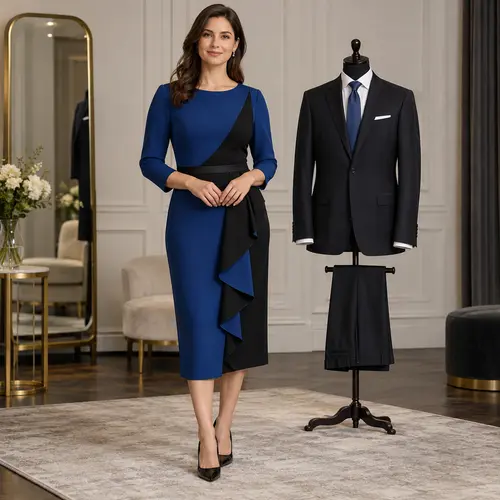


At a glance
- Navy Blue suit: choose a clearly brighter blue like royal blue or cobalt blue, not another navy blue
- Black suit or tux: royal blue, cobalt blue, and sapphire blue all pair cleanly
- Grey suit: match with a charcoal-based black placement rather than true black
- Midnight blue tux: treat it like navy blue, avoid a navy blue dress
Jump to a section
Suit by Suit
| # | Suit or tux colour | Advice |
|---|---|---|
| 1 | Navy Blue suit | Avoid a navy blue dress in a near-identical tone, the two can blur together in photos. Royal blue or cobalt blue gives clear contrast, or lean on the dress's black placement instead of trying to match the blue. |
| 2 | Black suit or tux | Royal blue, cobalt blue, and sapphire blue all pair cleanly, since the tux's black already coordinates with the dress's own black portion without any blue-matching needed. |
| 3 | Grey suit | Pair with a dress using a charcoal-based black placement (see the true black versus charcoal guide) rather than true black, so the two greys agree instead of competing. |
| 4 | Midnight blue tux | This reads closer to navy blue than to true black. The same caution as the navy blue suit row applies, avoid a navy blue dress for the same reason. |
FAQ
Does the dress need to match the suit exactly?
No, and an exact match is usually harder to pull off than a deliberate contrast. Coordinating tone (both cool-toned blues, for example) while keeping the specific shades different tends to photograph better than trying to find identical colours in two different fabrics.
Does the black portion of the dress need to match the suit fabric?
Not precisely, but choosing between true black and charcoal (see the blacks-that-aren't-black guide) based on the suit's own black or grey tone helps the two garments read as coordinated rather than coincidentally similar.
What if the suit is a rented tux with an unknown exact shade?
Ask the rental shop for the specific style name or a swatch photo before the event if possible. When that's not available, choosing a saturated, clearly-blue dress shade like royal blue or cobalt blue is safer than a navy blue that risks blending into an unknown near-black or navy blue tux.
Is coordinating with a suit even necessary?
It's a courtesy for photos, not a requirement. Plenty of well-dressed couples wear colours that complement rather than coordinate. It matters most for posed portraits where the two outfits sit side by side in the same frame.
Does a bow tie or tie colour matter as much as the suit itself?
Less so, since the suit's overall colour dominates the visual pairing far more than a smaller accessory like a tie. That said, a tie in a colour that echoes the dress's shade or black placement can tie the two outfits together as a small, deliberate detail.
What if the couple wants coordinated rather than contrasting outfits?
A coordinated look works by matching undertone and formality rather than the exact hex value, a cool-toned navy suit with a cool-toned sapphire or cobalt dress reads as coordinated without either garment needing to be an identical shade.
Does a patterned suit change this advice?
A subtle pattern, like pinstripe, follows the same underlying colour logic above; a bold pattern calls for a simpler, solid dress shade instead.
Related guides
Mariah Johnson
Editor, Blue and Black Dress
I maintain the shade index and the placement pattern guides on this site, verifying each hex value against real garment photography as I work through the list, and I keep the pairing tables current.
View full bioGet the shade updates
One email when a hex value gets re-verified or a new shade profile goes up. No spam, unsubscribe anytime.