How a Train Changes Where the Black Reads on a Blue Gown
By Mariah Johnson · Updated
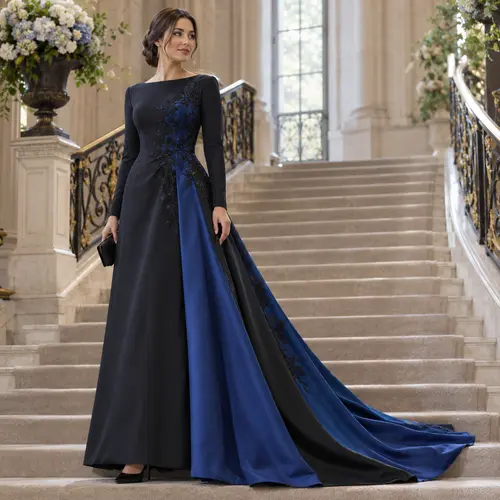
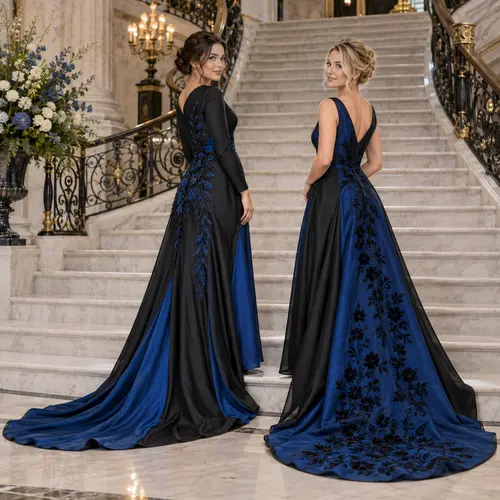
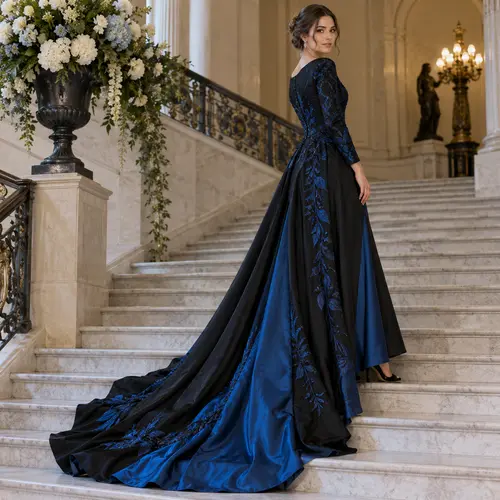
A train adds length that a placement pattern designed for a standard hem wasn’t built around. On a blue and black gown, that extra length can either finish a pattern beautifully or leave it visually unbalanced.
Whether it’s styled as a black and blue gown or a blue and black gown, a train changes the proportion math behind whichever placement pattern the dress uses.
At a glance
- Short trains (sweep, court): most placement patterns hold up with little change
- Chapel-length trains: enough length for an ombre gradient to read properly
- Cathedral trains: a bodice-only split can leave a long stretch of unbroken colour
Jump to a section
Train by Train
| # | Train | Length | Effect on the pattern |
|---|---|---|---|
| 1 | Sweep train | A few inches beyond the hem | A bodice split still reads clearly, the train barely changes the blue-to-black ratio. |
| 2 | Court train | Roughly three feet | A diagonal colour-block can look unbalanced if the black and blue division doesn't continue onto the train fabric itself. |
| 3 | Chapel train | Roughly five to seven feet | Enough vertical distance for an ombre gradient to finally read as a gradient rather than an abrupt line. |
| 4 | Cathedral train | Seven feet or more | A bodice-only split leaves a very long, unbroken blue train. Extending trim along the train's edge keeps the black from disappearing entirely. |
FAQ
Does train length change which placement pattern works best?
Yes, and more than most buyers expect. A pattern like a bodice split that looks complete at a sweep or court train length can leave several feet of unbroken colour once a chapel or cathedral train is added, which changes the overall visual balance of the gown.
Should the train match the bodice colour or the skirt colour?
There's no single right answer, but a train that continues the skirt's colour reads as one continuous garment, while a train in the contrasting colour, black extending from a blue skirt, reads as a deliberate design statement. Check the specific listing's photos rather than assuming.
Can a train be black without the dress looking like two separate garments?
It can, and it's one of the more striking uses of a colour-block pattern (see the nine placement patterns guide) at long lengths, but it depends on the transition being handled deliberately rather than as an afterthought. A hard, clean line at the train's start reads as intentional; a ragged or uneven transition reads as a fit issue.
Is a train practical for a full wedding day?
A long train, chapel length or beyond, adds real logistical weight to a day that already involves a lot of standing and moving. Many gowns with a longer train include a bustle option to shorten it for the reception. See the comfort guide below for more on fabric and structure across a long day.
Does the fabric of the train matter as much as its length?
Yes, a sheer or lightweight train shows more of what's underneath it, so a colour placed on the skirt can still read through a sheer train, while a fully opaque, structured train fabric hides anything beneath it completely.
Is a detachable train a good option for a placement-pattern gown?
It can be, since a detachable train lets you see and adjust how a pattern reads with and without the extra length before committing, and it also solves the practicality question for the reception without needing a built-in bustle.
Does train colour ever fade differently than the rest of the gown?
It can, since a train sees less direct light exposure than the front of the gown, though this is a minor, long-term consideration rather than an immediate concern.
Related guides
Mariah Johnson
Editor, Blue and Black Dress
I maintain the shade index and the placement pattern guides on this site, verifying each hex value against real garment photography as I work through the list, and I keep the pairing tables current.
View full bioGet the shade updates
One email when a hex value gets re-verified or a new shade profile goes up. No spam, unsubscribe anytime.